
Agroforestry and Agroecology
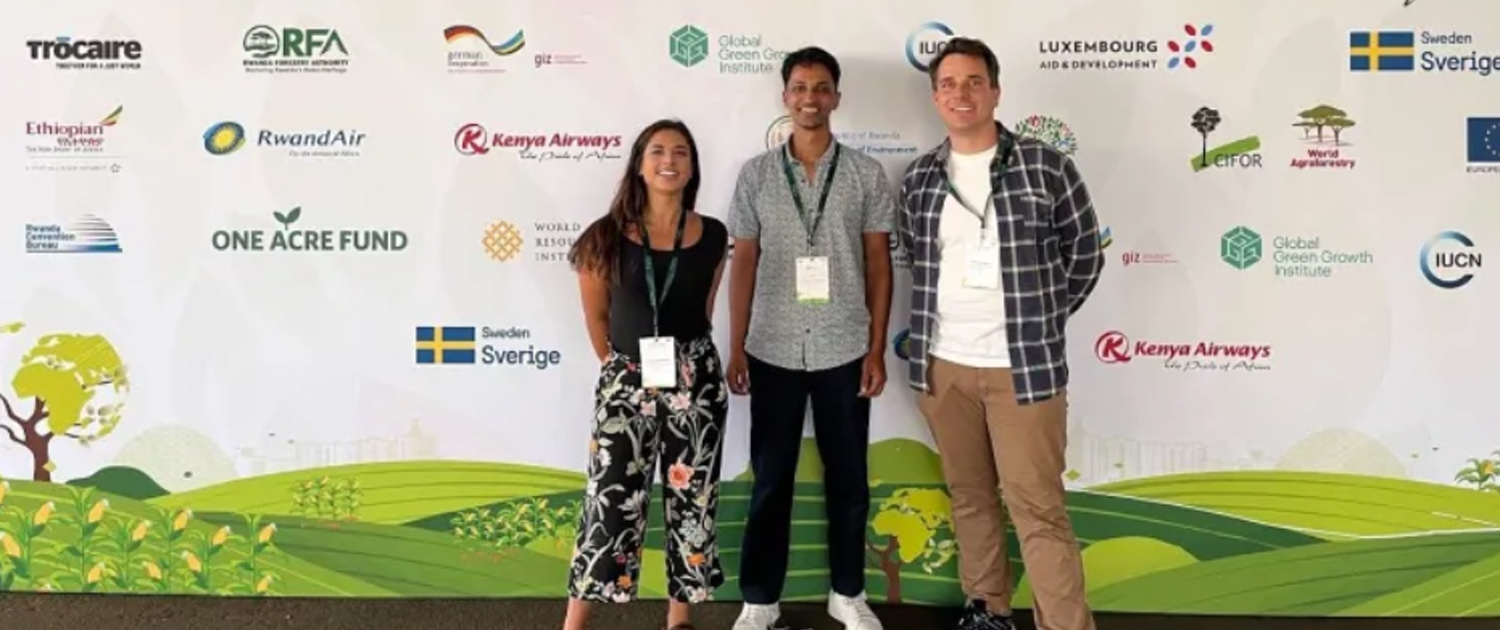
Reflections from the 2025 World Congress on Agroforestry in Kigali, Rwanda
By Michelle Nikfarjam
As the temperature in Burlington, Vt. plummets to near zero (don’t even ask me about the “feels like” temperature, spoiler alert: it feels COLD), I’ve been reflecting on warmer days. In mid-October, I traveled to Kigali, Rwanda as a delegate to the 6th World Congress on Agroforestry, representing the Institute for Agroecology (IfA) and Food Systems at UVM. I was there to share my PhD research on community food forests and learn from the 700-plus delegates from 63 countries, working across research, practice, policy, and civil society.
As I shared my research, listened to other presentations, and went on site visits, I was buoyed by the extensive work taking place in agroforestry across the globe. But, at the same time, I was grappling with the gaps – especially around participatory and community co-designed processes. There is a lot of good work happening, and we still have much to do.
About the World Congress on Agroforestry
The World Congress on Agroforestry (WCA) started in 2004 in Orlando, Fl., with the aspiration of creating a global forum for science, policy, and practice to move forward global agroforestry transitions. The WCA is now the place where the field of agroforestry periodically “re-anchors” itself, addresses new debates, tensions, and questions, and reflects on what has and hasn’t worked in practice. Convened by the International Union for Agroforestry (IUAF) with rotating host country’s Ministries of Environment, the WCA has strong participation from Center for International Forestry Research and World Agroforestry (CIFOR-ICRAF), the United Nations Food and Agriculture Organization (UN FAO), and other international partners.
This year’s WCA in Kigali was the sixth (following Nairobi, Delhi, Montpellier, and Québec City). Under the theme of “agroforestry for people, planet and profit,” Kigali built on the 5th Congress in Québec (2022), which called on agroforestry to support the “transition to a viable world.” The 6th Congress advanced this vision by examining the interconnected ecological, social, and economic challenges of scaling agroforestry.


